
































|
|
Family Recognition Beyond MarriageEditors: John Asland, Katrine Kjærheim Fredwall & Jens M. Scherpe Edition: 1st (16 September 2026) Pages: 408 Hardcover ISBN: 978-87-420-0081-6 Price: DKK 695 incl. VAT (DKK 3556 excl. VAT) Price: €94 incl. VAT (€75 excl. VAT) This volume contains some of the papers presented at the International Society of Family Law European Regional Conference that took place in Oslo on 12 and 13 May 2025 and which was co-organised by the Department of Private Law of the University of Oslo and the Nordic Centre for Comparative and International Family Law (NorFam). The overarching theme of the conference and this volume is ‘Family Recognition Beyond Marriage’, and the contributions cover a wide range of topics in this field, including de facto relationships/cohabitation, LGBTQIA+ families and polyamory, as well as family recognition more broadly and the legal position of children in modern families. Overview of Contents 1. Denise Amram & Roberta Romano, ‘Affectivity and New Technologies: Which Legal Impacts on Family Relationships?’ 2. Małgorzata Balwicka-Szczyrba & Anna Sylwestrzak, ‘Child Welfare in Formal and Informal Families – The Polish Perspective’ 3. Anne Barlow, ‘Cohabitation Law and Reform in England and Wales – Pure Chaos?’ 4. Giulia Binato, ‘“It Isn’t Over”: A Comparative Analysis of European Approaches on Extending Stepchild Adoption to the Parent’s Former Partner’ 5. Ingrid Boone, ‘In the Name of the Father, the Mother or Both? Gender Equality and Name Choice in Belgian Law’ 6. Rebeca Fariña Fariña, ‘Marriage, Filiation and Cohabitation. An Approach to the Transformation of Family Law in Spain’ 7. Hugues Fulchiron, ‘Thinking about relationships in stepfamilies throughout life’ 8. Lilla Garayová, ‘Redefining Parenthood in the Age of Human-Enhancement Technologies: A Children’s Rights Perspective’ 9. Federica Giardini, ‘Familia/Familiae: a Survey of Family Models in the Legal Systems of the Western Legal Tradition 10. Anabela Susana de Sousa Gonçalves, ‘Shaping Standards on International Child Abduction: The European Court of Human Rights’ Guidelines’ 11. Lucy Greenwood, ‘Dispelling the Myth that the Legal Rights of all Civil Partnerships/ Unions Worldwide are Equal to those of Marriage’ 12. Lucia Irinescu, ‘Family Recognition Outside of Marriage in Romania’ 13. Mai Ishijima, ‘Seeking Alternatives: Legal/Administrative Recognition of Same-Sex Couples in Japan’ 14. Zdeňka Králíčková, ‘Family Recognition Beyond Marriage in Czechia’ 15, Joëlle Long, ‘Reframing Family Through Language: How Words Recognise and Delegitimise Family Forms’ 16. Arnau Nonell-Rodríguez, ‘Multi-Partner Relationships and Quasi-Familial Regimes: A Comparative Perspective on Fallen-Short Recognition’ 17. Molshree Sharma, ‘Non-Traditional Families and Custody Rights: Hague Convention on the Civil Aspects of Child Abduction’ 18. Orsolya Szeibert, ‘Cohabitation as Informal Partnership on the Borderline Between New and Old Regulations in Hungary’ 19. Teiko Tamaki, ‘Marriage That Matters: Family Recognition Through Legal and Social Norms in Japan’ 20. Cinzia Valente, ‘The Challenges of a Future-Oriented Return to Multigenerational Family Models’ 21. Virginia Zambrano, ‘Different Family Models and the Difficult Path to Non-Discrimination: Between European Case Law and Divergent Strategies’ |
|
|
Introduction to EU Internet Law, 3rd editionAuthors: Jan Trzaskowski, Andrej Savin, Patrik Lindskoug & Björn Lundqvist Edition: 3rd (22 August 2023) Pages: 552 Hardcover ISBN: 978-87-420-0068-7 Price: DKK 495 incl. VAT (DKK 396 excl. VAT) Price: €67 incl. VAT (€54 excl. VAT) Introduction to EU Internet Law provides a thorough introduction to the parts of European Union law that are particularly relevant to the Internet, including electronic commerce. Its eleven chapters introduce, analyse and discuss a variety of legal topics and their application to activities on or relating to the Internet. This book will serve as a valuable resource for lawyers, legal academics and law students who wish to familiarise themselves with Internet law or update their knowledge. It is also suitable as a general introduction for readers without a law background whose skills may be more technological than legal. Jan Trzaskowski, Ph.D., is Law Professor at Copenhagen Business School and Aalborg University. Since the mid-1990s, he has dealt with legal and regulatory aspects of information technology. Andrej Savin, Ph.D., is Law Professor at Copenhagen Business School. His main research interests relate to information technology law, in particular Internet governance in the US and in Europe. His primary focus is on EU policymaking in the digital single market. Björn Lundqvist, LL.D., is Associate Professor at the Faculty of Law, Lund University. He has worked with commercial law and international e-commerce law since the mid-1990s. His major fields of interest are commercial law, international and comparative private law and property law. Patrik Lindskoug, LL.D., is Law Professor at Stockholm University. His research focuses on innovation, competition, property and law, and he takes a particular interest in the regulation of the digital economy. |

|
|
Vicarious Liability for Group TortsAuthor: Sara Spiro Svendsen Edition: 1st (24 August 2023) Pages: 272 Hardcover ISBN: 978-87-420-0057-1 Price: DKK 495 incl. VAT (DKK 396 excl. VAT) Price: €67 incl. VAT (€54 excl. VAT) Vicarious Liability for Group Torts examines the possibility to apply ordinary tort law rules, including vicarious liability theories, on the corporate group. The book analyzes the existing methods of reaching the pockets of parent company for subsidiary faults and then ask whether tort law could play a bigger role in holding the corporate group responsible. This question is debated based on a concurrency theory where the traditional veil piercing theory and tort law theories are treated as equivalent routes for liability – not as being in conflict with one another. The research finds that there are no insuperable obstacles in applying tort law on the corporate group. However, some adjustments will be required to overcome the limits imposed by the general principle of limited liability. |

|
|
Into the Northern Light – in memory of Steen TreumerAuthors: Carina Risvig Hamer, Marta Andhov, Erik Bertelsen & Roberto Caranta (red.) Edition: 1st (2 December 2022) Pages: 642 Hardcover ISBN: 978-87-420-0062-5 Price: DKK 795 incl. VAT (DKK 636 excl. VAT) Price: €107 incl. VAT (€86 excl. VAT) Steen Treumer is a well-known name to most people working with public procurement law in Denmark and internationally. Professor Steen Treumer passed away on 16 August 2021, and this book will be presented at a conference in his honour on 2 December 2022 at Copenhagen University. The many contributions in this book are divided into five parts: (1) Public Procurement Principles, (2) Procurement Procedures, (3) Modifications of procurement procedures and contracts, (4) Enforcement of the EU procurement rules and (5) Outside procurement – inside other related rules. |

|
|
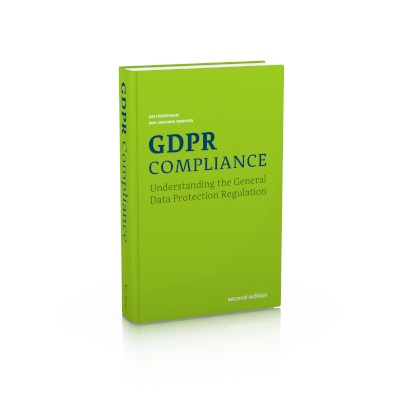
GDPR Compliance – Understanding the General Data Protection RegulationAuthors: Jan Trzaskowski & Max Gersvang Sørensen Edition: 2nd (1 September 2022) Pages: 460 Hardcover ISBN: 978-87-420-0052-6 Price: DKK 465 incl. VAT (DKK 372 excl. VAT) Price: €63 incl. VAT (€50 excl. VAT) The processing of personal data plays an increasingly important role in our modern information society. This book guides the reader through the legal framework—including case law—relating to the processing of personal data in the European Union and provides tools to ensure compliance by businesses. This revised second edition is up-to-date as of 1 August 2022 and includes the text of the General Data Protection Regulation for easy access and annotation. Jan Trzaskowski, Ph.D., is professor of data protection law and market law at the Copenhagen Business School and Aalborg University. Max Gersvang Sørensen is Senior Digital Business Counsel at the Gorrissen Federspiel Law Firm and has wide experience with the implementation of personal data strategies. |

|
|
The Business Judgment Rule in Danish LawAuthor: Søren Bergenser Edition: 1st (7 January 2022) Pages: 224 Hardcover ISBN: 978-87-420-0046-5 Price: DKK 395 incl. VAT (DKK 316 excl. VAT) Price: €54 incl. VAT (€43 excl. VAT) The Business Judgment Rule in Danish Law provides a full overview of the Danish version of this legal doctrine, which is a turning point in most disputes regarding the liability of directors and officers in Danish companies. The recent Supreme Court decisions regarding the liability of directors and officers in bankrupt banks have developed the doctrine in Danish law. The doctrine is put into context by a thorough comparative study with, primarily its US/Delaware ‘mother’, which provides an understanding of this doctrine, born in a common law jurisdiction, and transferred to the Danish civil law legal system. The book provides insights into the different standard liability situations, known in Danish law, and a thorough examination of a large number of Danish court decisions, distilling how the doctrine applies in different standard liability situations. Søren Bergenser is a practicing attorney and holds a Ph.D. in law from the University of Copenhagen. He is also external lecturer at Aalborg University. |

|
|
Your Privacy Is Important to Us! – Restoring Human Dignity in Data-Driven MarketingAuthor: Jan Trzaskowski, with a foreword by Eric K. Clemons Edition: 1st (30 november 2021) Pages: 352 Hardcover ISBN: 978-87-420-0042-7 Price: DKK 395 incl. VAT (DKK 316 excl. VAT) Price: €54 incl. VAT (€43 excl. VAT) Your Privacy Is Important to Us! explores the application of EU consumer law—including data protection law and other fundamental rights—to data-driven business models that infringe on human agency, social cohesion and democratic debate. It suggests how our current legal framework can be informed by psychological, technological and societal perspectives to curb predatory business models of surveillance capitalism. The book elucidates the potential for cross-fertilisation between data protection law and marketing law, and it demonstrates how the protection of human dignity, privacy and non-discrimination may corroborate these legal disciplines. It is argued that ‘paying with personal data’ is a misleading framing when, in fact, we pay with attention and agency—which are both scarcer and more precious than personal data and are also important in social and societal contexts. A three-tiered model of information asymmetry is introduced to illustrate why information does not ensure transparency, which is a prerequisite for user empowerment. The aim is to inform and amplify ongoing debates by providing a coherent framing of data-driven marketing in the context of law, psychology, technology and society. Jan Trzaskowski, Ph.D., is Law Professor at Copenhagen Business School and Aalborg University. Since the mid-1990s, he has dealt with legal and regulatory aspects of information technology, and his research focuses on the protection of consumers and fundamental rights, including privacy. He was Head of the Danish delegation negotiating the 2000 E-Commerce Directive and is founder of the Business in Democracy Initiative (BiDEM). Eric K. Clemons, Ph.D., is Professor Emeritus at The Wharton School and author of New Patterns of Power and Profit. OFFER: Book (DKK 395) + Mug (DKK 120) = free worldwide delivery DKK 515,- incl. VAT (DKK 412/€56 excl. VAT). |


|
|
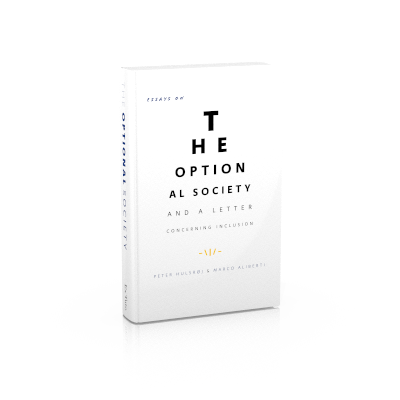
Essays on the Optional Society – and a Letter Concerning InclusionAuthors: Peter Hulsrøj & Marco Aliberti Edition: 1st (19 November 2021) Pages: 336 Hardcover ISBN: 978-87-420-0039-7 Price: DKK 295 incl. VAT (DKK 236 excl. VAT) Price: €40 incl. VAT (€32 excl. VAT) The Optional Society adopts the unique approach of looking at societal change from the perspective of the avalanche of options we are currently exposed to and will be confronted with to an even greater extent in the future. This new world will face us with personal and societal challenges that it is important that we address urgently and with proper consideration. The book draws on many sources and covers a great range of domains, from artificial intelligence over genetics, democracy, Big Tech, historiography, to arts, virtual life and sex, whilst placing these diverse elements in the context of general political and social thought. It reconceptualises human rights, puts a question mark against received constitutional law wisdom, and challenges the validity of legal dualism in a world where not only humans but also issues are increasingly interconnected! |

|
|
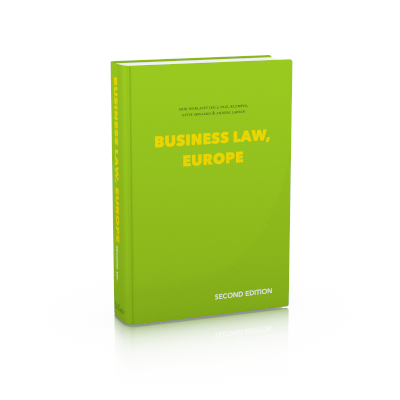
Business Law, Europe , 2. udgaveAuthors: Erik Werlauff (ed.), Paul Klumpes, Gitte Søgaard & Anders Larsen Edition: 2nd (21 September 2021) Pages: 544 Hardcover ISBN: 978-87-420-0053-3 Price: DKK 695 incl. VAT (DKK 556 excl. VAT) Price: €94 incl. VAT (€75 excl. VAT) Business Law, Europe is a must-have for any business advisor that operates on a cross-border level in Europe. The book is also for students and teachers who desire a deeper understanding of the business and corporate rules we share in the EU countries, EEA countries, and the UK Whether you already have solid knowledge about doing business in Europe or just taking your first steps on this corporate scene, this book should be within your reach. |

|
|
Big Science and the LawAuthors: Ulf Maunsbach & Axel Hilling (ed.) Edition: 1st (14 July 2021) Pages: 272 Hardcover ISBN: 978-87-420-0036-6 Price: DKK 495 incl. VAT (DKK 396 excl. VAT) Price: €67 incl. VAT (€54 excl. VAT) The European Spallation Source (ESS) is a state-of-the-art neutron scattering facility, built on the outskirts of Lund in Southern Sweden, and expected to be taken into scientific operation in 2023. It is funded, run, and built by a consortium of thirteen (to date) European governments who jointly provide for its funding and establish its overarching governance principles, and it is co-hosted by Sweden and Denmark, with the main facility in Lund and a data-center in Copenhagen. The ESS has been subject to some studies in the history and sociology of science and similar facilities in other countries is also a popular topic for studies of the politics, funding and organization of science today Previously unexplored, however, are the many interesting legal aspects of Big Science in its contemporary form. This book, written by a number of legal scholars at Lund University and associates in the private sector, makes the first scholarly attempt to fill this gap, using the fact that the ESS is located in Lund and Copenhagen and is under construction, which makes the preconditions formidable for studies of Big Science and the law. This book includes a variety of legal areas focused on potential problems that are related to Big Science: labour law, intellectual property law, law of associations, environmental law and tax law. |

|
|
VAT Grouping & Cost Sharing — a critical and constructive perspectiveAuthors: Karina Kim Egholm Elgaard, Dennis Ramsdahl Jensen, Anders Mikelsen & Marta Papis-Almansa (eds) Edition: 1st (22 December 2020) Pages: 280 Hardcover ISBN: 978-87-420-0026-7 Price: DKK 395 incl. VAT (DKK 316 excl. VAT) Price: €54 incl. VAT (€43 excl. VAT) This anthology pursues discussion on the rules on VAT grouping and the cost-sharing VAT exemption in a critical and constructive academic setting. While the focus is on the harmonised European VAT, lessons from other jurisdictions are also taken into consideration. Numerous issues and problems with the two sets of rules are scrutinised in this series of articles written by internationally renowned professors and experts in VAT/GST law. |

|
|
Earn-Out DisputesAuthors: Niels Schiersing Edition: 1st (3 June 2020) Pages: 324 Hardcover ISBN: 978-87-420-0034-2 Price: DKK 1245 incl. VAT (DKK 996 excl. VAT) Price: €168 incl. VAT (€134 excl. VAT) This book covers substantive and procedural issues regarding ‘earn-out’ provisions, i.e. purchase price adjustments based on the performance of the business (‘the target’) after the consummation of the transaction. Earn-out clauses often give rise to disputes between the buyer and the seller, and this book provides a reference to and an analysis of case law from a number of major business jurisdictions, including Delaware, New York, England, Australia and New Zealand. Niels Schiersing is qualified as both an advocate (Denmark) and a solicitor (England & Wales). He specialises in contract law and focuses his practice on serving as arbitrator in commercial arbitrations across several continents. |

|
|
Fair Taxation and Corporate Social ResponsibilityAuthors: Karina Kim Egholm Elgaard, Rasmus Kristian Feldthusen, Axel Hilling & Matti Kukkonen (red.) mfl. Edition: 1st (27 November 2019) Pages: 272 Hardcover ISBN: 978-87-420-0025-0 Price: DKK 395 incl. VAT (DKK 316 excl. VAT) Price: €54 incl. VAT (€43 excl. VAT) Taxation and CSR is becoming an ever-important concept among multinational enterprises (MNEs), but its meaning and its impact on corporations and societies are still uncertain. Despite the lack of common understanding of the meaning of responsible tax behaviour, the concept of ‘responsible tax behaviour among MNEs’ is materialising as one of the main pillars of CSR. In this anthology, internationally renowned researchers and specialists grapple with and explore relevant themes within: Taxation and CSR in Perspectives, Taxation and CSR in Practice and CSR and Taxation in Regulation. This book delivers new insight and knowledge on this important and ever-developing topic. The anthology is the keystone of an international conference on Fair Taxation and Corporate Social Responsibility (CSR) held at the University of Copenhagen in 2018 organised jointly by the University of Copenhagen, Lund University and Hanken School of Economics Helsinki. |

|
|
Copyright, to be or not to beAuthors: Jørgen Blomqvist (red.) Edition: 1st (4 June 2019) Pages: 356 Hardcover ISBN: 978-87-420-0004-5 Price: DKK 695 incl. VAT (DKK 556 excl. VAT) Price: €94 incl. VAT (€75 excl. VAT) This book contains the papers presented at the ALAI Congress in Copenhagen on May 18–19, 2017. Today, the protection of copyright and related rights is as controversial as ever before. It reaches into our everyday activities on the internet and is by many seen as an impediment to the free flow of information, culture and entertainment. The Congress examined in depth not only why this protection came about, but in particular also which role it plays in modern society. Some of the leading experts in the world discussed the issues under the following headings: the traditional justifications for copyright and related rights; economic aspects of copyright and related rights; individual and collective licensing as a means of improving the functioning and acceptance of copyright and related rights; and general tendencies and future developments. The general reports, which are based on questionnaires from a large number of ALAI’s national groups, are published in English, French and Spanish, whereas other papers are published in one of these languages, as it was presented. |

|
|
Perspectives on Energy Law: Denmark and BeyondAuthors: Anita Rønne; edited by Beatriz Martinez Romera, Cătălin-Gabriel Stănescu & Martha Roggenkamp Edition: 1st (24 May 2019) Pages: 244 Hardcover ISBN: 978-87-420-0024-3 Price: DKK 495 incl. VAT (DKK 396 excl. VAT) Price: €67 incl. VAT (€54 excl. VAT) Perspectives on Energy Law contains some of the key legal writings of Associate Professor Anita Rønne, from 1985 to 2018. The book emerges from a deep sense of respect and appreciation for Anita, who was a dear friend and colleague, and aims to be a tribute to her contribution to the development of the Energy Law field. |

|
|
Where Do We Stand on Discounts? – A Nordic PerspectiveAuthors: Christian Bergqvist (ed), Vladimir Bastidas, Henrik Ballebye Okholm, Torben Thorø Pedersen & Eirik Østerud Edition: 1st (14 December 2017) Pages: 208 Hardcover ISBN: 978-87-420-0014-4 Price: DKK 395 incl. VAT (DKK 316 excl. VAT) Price: €54 incl. VAT (€43 excl. VAT) Dominant undertakings’ ability, under competition law, to award discounts and other loyalty inducing considerations are subject to much ambiguity and unsettled issues. Despite discounts being a commercial requirement, even for the dominant undertaking, it is difficult to draw up clear principles. And while the approach to non-dominant undertakings restriction of competition has been fundamentally recast over the last 20 years, the appraisal of single company behaviour remains more formal and rigid. However, recently there have been indications that some of the same leniency might have been extended to discounts and unilateral behaviour and in particular the 2017 Court of Justice ruling in Intel has reopened the discussions. The objective of this book is to provide guidance on the matter under EU and Nordic competition law and to align these with economic theory. |

|
|
The Wired World of University Teaching – Legal ChallengesAuthors: Laura Carlson, Cecilia Magnusson Sjöberg & Frantzeska Papadopoulou Edition: 1st (30 August 2017) Pages: 192 Hardcover ISBN: 978-87-420-0001-4 Price: DKK 395 incl. VAT (DKK 316 excl. VAT) Price: €54 incl. VAT (€43 excl. VAT) The digitalization and commercialization of teaching raise both new and old questions with respect to academic freedom, copyrights to teaching materials, employment rights, open access and data protection, public sector information, and transparency. When traditional academic learning is challenged, academic freedom and the protections of privacy and moral rights are essential. |
